
NVIDIA Jetson edge computer
Runs computer vision, neural-network inference, grasp planning and high-level ROS 2 coordination.
Projects · Robotics and AI
A modular robotic hand and forearm platform combining mechanical engineering, sensing, real-time control, computer vision and edge AI.
The Intelligent Robotic Hand is a modular robotic manipulation platform intended to combine mechanical design, sensing, deterministic motor control, computer vision and edge artificial intelligence.
The central research question is whether a hand can adapt its grasp to objects with different shapes, orientations, weights and fragility without requiring an engineer to program every finger movement separately.
Development begins with measurable sub-systems, including human-hand motion capture, an index-finger and thumb mechanism, force and position sensing, and real-time motor control. These results will inform the design of the complete multi-finger prototype.
Development evidence
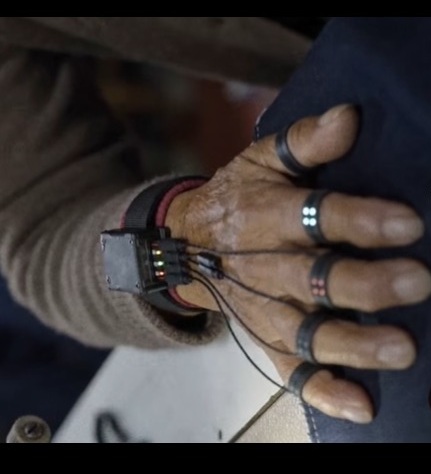
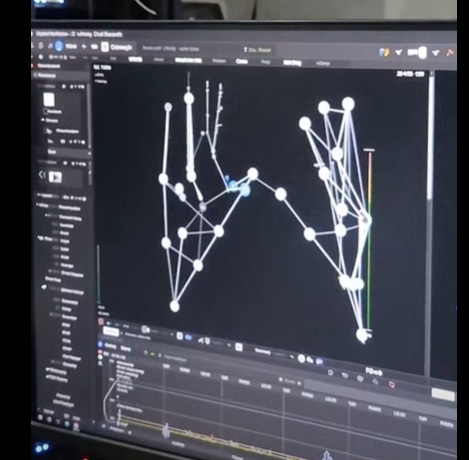
These images illustrate early work used to understand human-hand movement, joint relationships and sensor input before those behaviours are translated into a robotic mechanism.
Potential value
Traditional grippers are excellent when an object and task are predictable. A sensor-rich adaptive hand may create value where products, positions or handling requirements change.
Technology stack
The architecture separates high-level perception and planning from time-critical local motor control. This allows advanced AI processing without sacrificing deterministic response and safety.
Runs computer vision, neural-network inference, grasp planning and high-level ROS 2 coordination.
An STM32H7, Teensy-class or equivalent controller executes deterministic motor loops, sensor acquisition and local safety logic.
The complete concept may use approximately fifteen actuators, with each joint requiring suitable drive electronics and current protection.
Encoders, Hall sensors or potentiometers provide position feedback, while current, pressure, force or tactile sensors support controlled contact.
ADC hardware such as ADS1115, ADS1015 or MCP3008 can acquire analogue force, flex and pressure signals.
EtherCAT or another validated deterministic link transfers commands and feedback, supported by watchdogs, limits and emergency-stop behaviour.
The Jetson software stack accelerates computer vision and neural-network inference at the edge.
Used for image processing, perception, data preparation, testing and application-level control.
Supports training or integrating perception and learning models, followed by optimisation for edge deployment.
Provides modular nodes for vision, grasp planning, hand control, telemetry, logging and system integration.
Runs local motor-control tasks, sensor sampling, fault handling and watchdog logic on the ARM controller.
Independent high-frequency control loops regulate joint position, velocity or force, with future scope for learning-based adaptation.
Control workflow
A grasp command becomes a coordinated sequence of perception, planning, deterministic control and sensor feedback.
Validation
Success should be demonstrated with measurable engineering evidence rather than attractive demonstrations alone, because robots have suffered enough from marketing departments.
Related live workspace
View related research, modelling, simulation and engineering development in the live RML environment.
Development roadmap
Phase 1
Validate linkage, force, actuation, sensing, control and safety.
Phase 2
Combine multiple digits, perception, planning and industrial communication.
Phase 3
Test a narrow application and quantify performance, cost and value.